For the first time, I have 100% of my available funds invested. The recent market drop has presented buying opportunities that I've not been able to pass up. So now I'm ready for a market run-up!
I've been able to follow my planned strategy and have observed rules relative to my buy-in price as the basis for making purchase decisions.
Strategy Rule Actual
Premium 25% 26.2%
Average 50% 28.1%
Discount 25% 45.7%
So I've actually been able to get in at more attractive prices that I anticipated, so this should provide great yields when I sell.
The big question is...When will I get an opportunity to sell? That hard to say. Obviously, I'm hopeful that the market will turn around soon and I'll be able to cash out these positions. But realistically, this probably will not happen quickly. So I may be dependent upon dividend income for the coming months. That's not so bad, as my current portfolio yields 3.92%, which is not so bad and is above current CD yields.
It's also worth pointing out that I'm not entirely shut out and can continue to invest if prices stay depressed. I have a small CD maturing this month that will roll into the ingestible funds pool and some larger CD maturing in August that will increase my ingestible funds by about 30%. So I'd prefer an immediate market turnaround, but I also have a strategy to continue to buy into an extended bull market.
Saturday, February 13, 2010

Friday, January 29, 2010
January 2010 Trading
January was an interesting month. The last two weeks were brutal, costing me all of my unrealized gains, but giving a great opportunity for buying what appeared to be bargains. But the continued drops made these bargains seem less like a good idea. Realized gains were very modest, being the second lowest month to date. But I'm 72% invested, so I'm positioned to capitalize on market upturns. Although the total was relatively small, the gain percentage was 11.56%, the second highest month to date.
It's also worth mentioning that I transferred a significant amount of cash out of the investment pool, so the drastic jump in invested percentage is a function of a smaller pool, plus a higher amount of invested funds.
I sold the following:
It's also worth mentioning that I transferred a significant amount of cash out of the investment pool, so the drastic jump in invested percentage is a function of a smaller pool, plus a higher amount of invested funds.
I sold the following:
- Nokia
- Buckle, Inc
- Lockheed Martin Corp - Up 1.9%
- Exxon Mobil - Down 3.6%
- FPL Group - Down 2.3%
- Owens and Minor, Inc. - Down 1.4%
- Exelon Corp - Down 1.7%
Saturday, January 9, 2010
2009 Performance against Metrics
I've been tracking metrics for the last few months, and the new year is a traditional time to assess past performance and reevaluate the plans for the new year. So here goes.

Yield

Percent Invested

Holding Period
Summary
Income
The reason that I began this exercise was to try to replace lost income at a time when I wasn't working. Although the unemployment didn't last long, it's still my goal to be able to match my net income from a job. Amazingly, I was able to do this on average. In fact, there was one month that I even matched my gross income. Since I will eventually need to pay taxes on these earnings, if I was able to be able to duplicate this feat on a monthly basis, I would no longer feel the need to work. Alas, that's not yet the case.


Yield
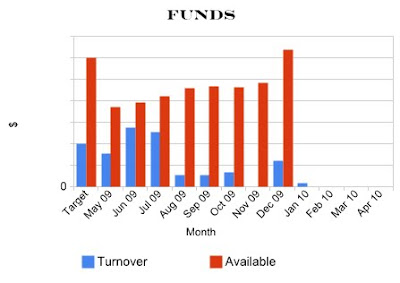
I've also been able to meet my my goals in terms of yield. I measure yield in two ways. First, I measure the percentage yield in terms of the amount turned over as part of the realized gain. If I bought $10,000 worth of stock and sold it at $11,000 for a gain of $1,000, my turnover yield would be 10%. If I had $100,000 funds for investing at the end of the period, then the available yield (or portfolio yield) associated with that transaction would be 1%. I've surpassed my 5% goal for turnover yield with an actual yield of 8.49%. 2.49% also surpasses my available yield goal of 2%. This second goal has been compromised a bit by my movement of additional funds into the available pool by transferring IRAs in from other accounts.


As noted above, I've brought in additional funds that have actually put me over my target for this investing pool. This would be great if I was always fully invested along with meeting my yield goals. But it's proven difficult to stay invested (and maintain high levels of realized gain). So I'm currently struggling with my options for these excess funds. I could keep them in the pool for possible investing, or I can invest in CDs, or I can look at putting some of these funds in a longer term stock position. This is proving to be a difficult decision due to the low yields in CD and dividends in the current environment. But I have some other CDs maturing in the next 6-8 months, so I need to develop an appropriate strategy for this.

Percent Invested
As I've said, staying invested is a challenge. My hope is that I would stay 50% invested with constant buying and selling. But the reality is that there are periods of acquisition and periods of disposition that follow general market trends. So the percent invested swings significantly. The chart below is not really representative since it only shows the values at the end of the month. There are typically intra-month peaks and valleys too.

Holding Period
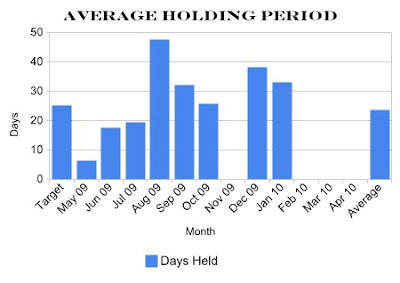
Obviously a short holding period is a good thing assuming that yield goals can be met. But given the low percentage invested, I've trended toward longer holding periods in recent months in order to eek out a few more basis points of yield. I've really struggled with this concept. On one hand, I had good luck during my first few months by taking a quick 5% yield, dumping the stock and then reinvesting in the same stock when it dropped back to my initial buy-in price. But I saw a lot of cases where the stock continued to rise after I sold and I didn't like leaving that money on the table. At the same time, I've seen stocks rise to 7-8% yields and I've held out for 10% only to see it drop the the initial levels. I guess this only goes to prove the old adage that "you can't time the market."

Summary
Although I haven't been able to hit all my goals, this experiment has proven successful beyond my expectations and is certainly worth of ongoing attention and refinement. Although you can't time the market, I will continue to try with most of my current efforts focused on how to determine the best buy-in time. This should boast my percentage invested. Then I'm sure the pendulum will swing and I'll be focused on when I should get out of a position. If nothing else, this has proven to be an interesting, challenging and most importantly, profitable venture.
Thursday, December 31, 2009
December 2009 Trading
December represented a significant improvement over the last few months. It was the third highest month yet for realized gains (best since July) and percentage yield (10.45%, just one basis point behind the second highest month).
I sold the following:
I sold the following:
- FPL Group, Inc
- Public Service Enterprise Group, Inc
- Exelon Corp
- Owens and Minor, Inc.
- Lockheed Martin Corp - Up 3.0% - I've now held some of these shares for almost 5 months.
- Nokia - Down 2.0% - small holding, but I've not been inclined to double-up because of the beating that it's been taking from Apple and RIM.
- Buckle, Inc - Up 9.3% - Almost met my sell price a few times. Hopefully this will go over the top in the next few days. And if not, it goes ex-div in mid-January.
- Exxon Mobil Corp - No gain - Been up and down, ex-div in mid-February.
This is the largest dividend collection month to date with about 1/6th of the realized gain coming from dividends! I collected dividends on the following:
- Exelon Corp
- FPL Group, Inc
- Owens and Minor, Inc.
- Lockheed Martin Corp
Thursday, December 3, 2009
Back On Track!
Whew, I was a bit worried after such a slow month in November, but I've sold stock on each of the first three days of December plus made a new purchase today. December already promises to be the best month for realized gains since July and the yield is running about 10%. I'm still holding about 40% of available cash in stocks, so there's plenty of upside from here too.
Subscribe to:
Posts (Atom)